




Blog
High-Speed Doors for Air-Supported Structure Accesssss

Introduction
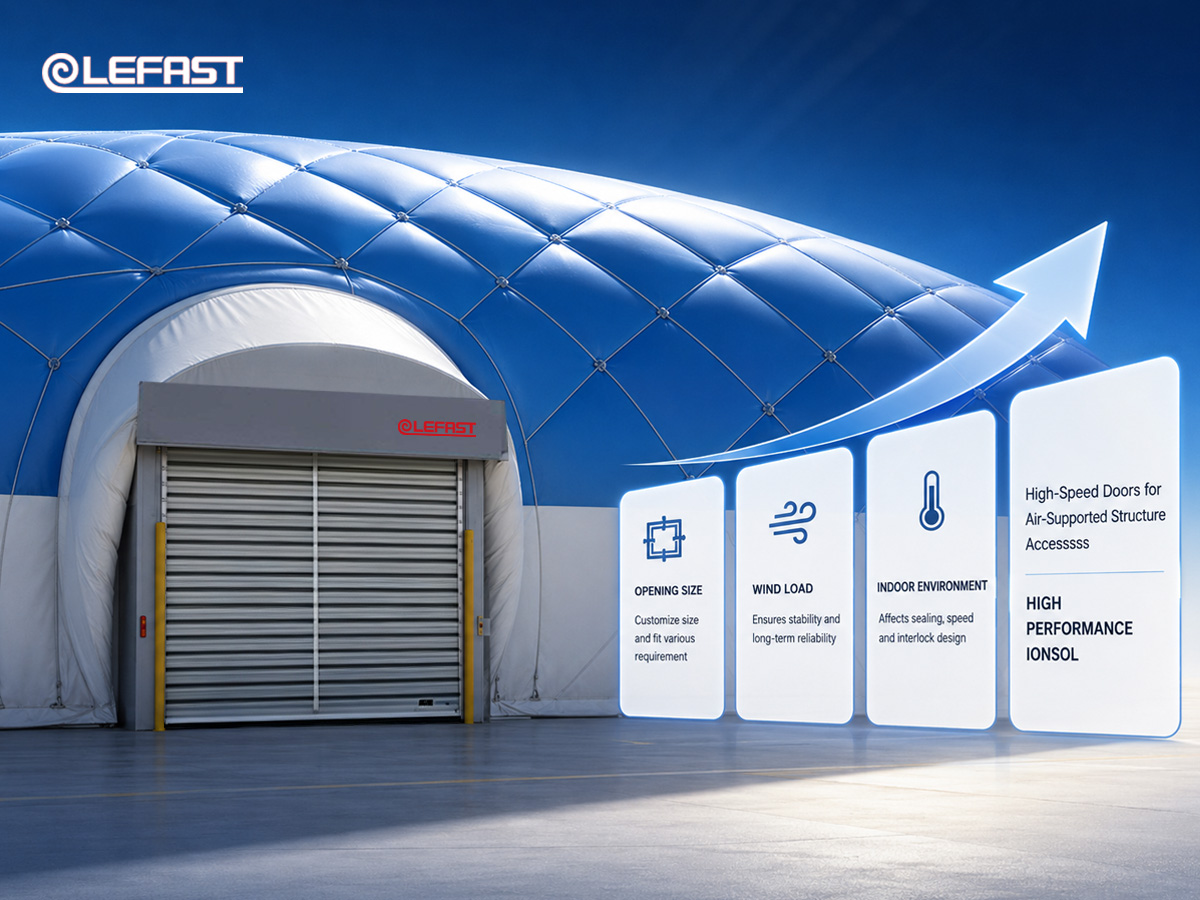
Air-supported structures rely on internal air pressure to stay inflated, so their entrances are very important and need special consideration.
Insulated high-speed doors as one option for limiting air and temperature exchange, while an interlock system can prevent two doors from opening at the same time and reduce pressure loss.
For the air-supported structure projects,we should take a consideration on traffic, insulation, pressure, opening size, and interlock requirements.
1. What is High Speed Door for Air-Supported Structures?
An air-supported structure relies on internal air pressure to maintain its shape, so its entrances should be treated like special application .Every door cycle affects the exchange of air between the inside and outside.
A high-speed door , means the opening speed up to 0.6-2.5m/s(adjustable ), for this type of building is designed to provide fast access while helping limit the time the opening exposed. Depending on the project, two high speed doors would be used as interlocked internal and external door, show insulation and wind resistance.
These doors are commonly used for vehicle, forklift, equipment, and personnel access in sports facilities, warehouses, industrial buildings, and other air-supported structures.
therefore ,the right door is selected according to the opening size, traffic frequency, environmental conditions, and requirements of the air-supported structure.
Back to Table of Contents2. Why Insulation, Wind-resistance, Speed Important for Air-Supported Structures Doors?
There is internal air pressure in the air-supported structure, so its doors need to do more than simply open and close to maintain the structure’s shape.
Insulation helps reduce temperature and air exchange
Between the inside and outside, especially when the entrance connects to an outdoor area or another temperature-controlled space.
Wind resistance matters at exposed entrances.
Air-supported structures are sensitive to wind conditions,so a door with suitable wind resistance can help keep the entrance stable and reduce the impact of wind on the structure.
Speed matters every second the door stays open is another second for air to escape.
For entrances used frequently by people, forklifts, or vehicles, fast opening and closing helps keep the opening exposed for less time.
Back to Table of Contents3. Where Are High Speed Doors used in Air-Supported Structures
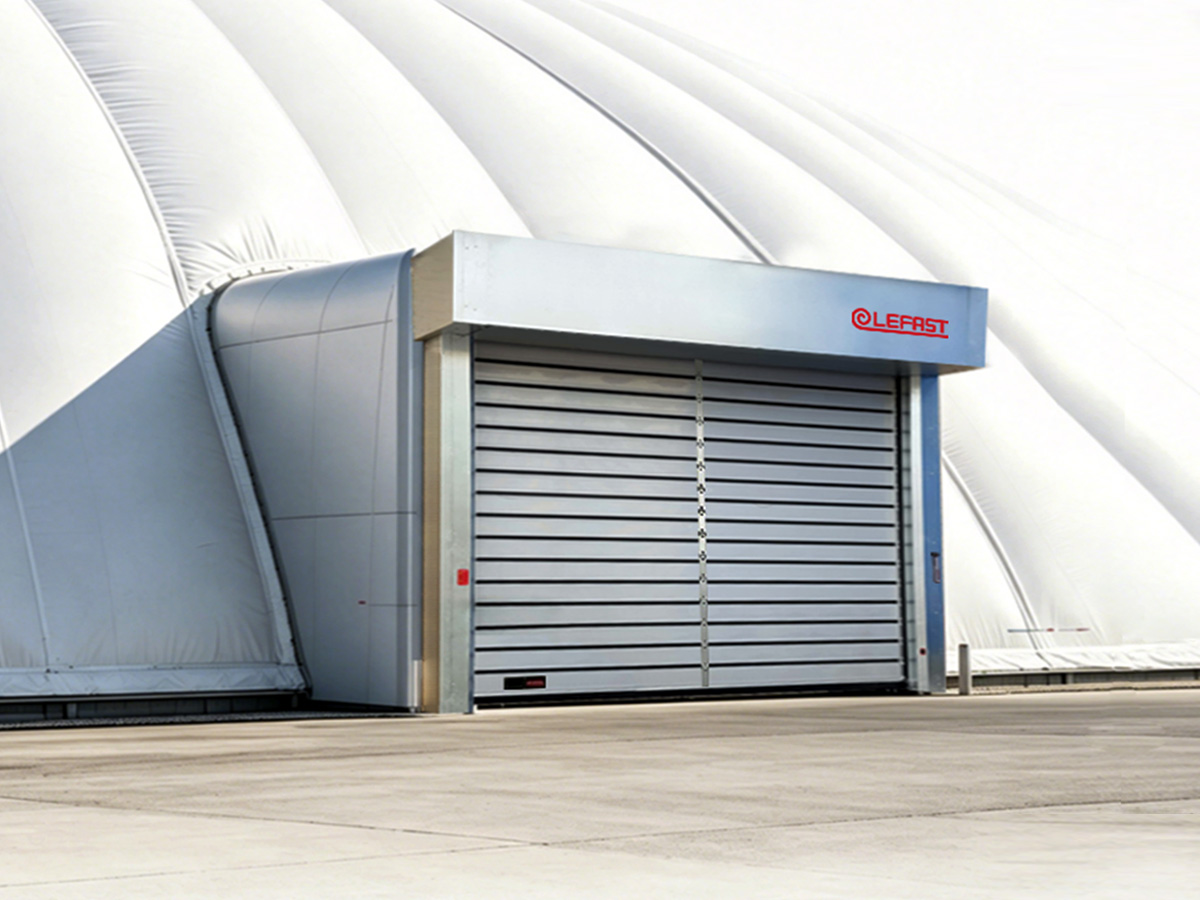
High-speed doors can be used wherever an air-supported structure for people, vehicles, or equipment.
Typical applications include:
- Sports & recreation facilities Access for athletes, visitors, maintenance equipment, and sports vehicles.
- Warehouses & logistics facilities frequent forklift, pallet, and vehicle movement.
- Industrial facilities Access between production areas, storage areas, and outdoor spaces.
- Special environments Temporary structures, wind-exposed locations, and other projects with specific entrance requirements.
 Back to Table of Contents
4. Key Benefits of High-Speed Doors in Air-Supported Structures
High-speed doors can make access easier to manage in air-supported structures, especially where the entrance is used frequently.
5. What Features Should A High Speed Door for Air-Supported Structures Have
A high-speed door for an air-supported structure should be configured based on the building structure and how the entrance is used. Key features may include:
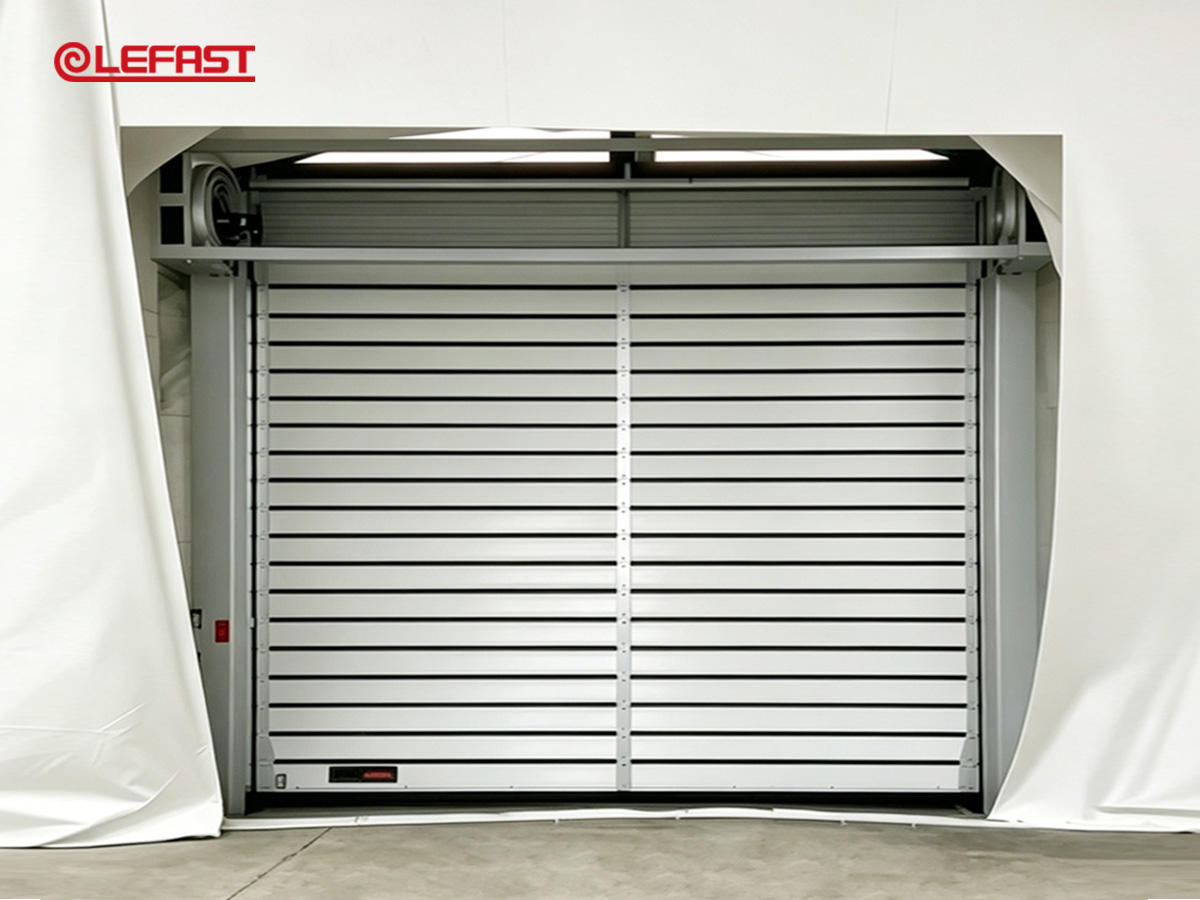
Insulated Door Construction
Insulated door panels are available in traditional insulated panels and thermal-break insulated panels. A thermal-break design provides better thermal performance in separation between the inside and outside surfaces.
However, thermal-break construction is not necessary for every opening. For doors that are used less frequently or where insulation requirements are relatively low, traditional insulated panels can also be a practical option.
Wind Resistance for Air-Supported Structures
Wind resistance is closely related to the strength of the door panel and the way individual panels are connected.
For thermal-break insulated high speed door panels, foam density is one detail worth checking. A density of around 45–50 kg/m³ provides a useful reference when evaluating panel strength, but it should be considered together with the panel construction and connections.
A door panel needs to work as a connected structure rather than as a series of loosely joined sections. When comparing doors, look beyond the stated wind-resistance rating and check how the panels are actually constructed.
Sealing Around the Opening
For an air-supported structure, sealing should be considered not only around the entire opening. but also entire closing. The door panel, side guides, upper and bottom area should work together to limit gaps when the door is closed. This overall approach to sealing is more useful than focusing on materials of a single sealing component .
Fast Operation
Typical high speed door operating ranges are 0.8–2.5 m/s for opening and 0.6–1.2 m/s for closing. At these speeds, a door of opening H4.5 m can be fully opened within 2–6s, then fully closed in 4-8s, depending on the selected setting, this means less time for the opening exposed.
Safety Protection
Basic protection can include infrared photo sensors and bottom anti-crush protection, light curtain is optional, helping detect obstacles and reduce the risk of contact during operation.
Interlock for Two-Door Entrances
For entrances with two doors, an interlock system prevents both doors from opening at the same time.
One door must close before the other opens.This helps maintain internal pressure and reduces the risk of structural instability.
 Back to Table of Contents
6. High Speed Air-Supported Structures Door vs. Standard Industrial Doors
An opening speed above 0.6 m/s is commonly used to distinguish high speed doors from conventional industrial doors, speed is only part of the story. Construction and intended use matter too.
Not every “fast” door is a high speed door—and not every entrance needs a high speed door.
high speed fabric doors cover several constructions, including rolling, folding, self-repairing and zipper doors. Their detailed configurations vary, but they share the basic characteristics of flexible PVC curtain systems.
The comparison as below :
| Factor | High Speed Spiral Door | High Speed Fabric Door | Sectional Door | Roller Shutter Door |
|---|---|---|---|---|
| Door Panel / Curtain Construction | Insulated aluminium panels | PVC curtain | Insulated aluminium/steel panels | Metal slats / panels |
| Door Panel / Curtain Thickness | 40/43/60/80/100 mm | 0.8/1.2/1.8 mm | 40/50 mm | 20 mm |
| Opening Speed | 0.8–2.5 m/s | 0.6–1.5 m/s | 0.25–0.5 m/s | 0.1–0.25 m/s |
| Closing Speed | 0.6–1.2 m/s | 0.6–1.0 m/s | 0.15–0.2 m/s | 0.1–0.1 m/s |
| Insulation | Thermal-break / insulated | Depends on curtain construction | Insulated panels | Depends on door construction |
| Sealing | Full perimeter sealing | Side & bottom sealing | Seals at panel joints and bottom | No |
| Safety Protection | Infrared / light curtain + Safety edge | Infrared Safety edge (Optional) | Infrared | Generally no |
| Cycle Capacity | Up to 2,000 cycles/day | High-frequency | Moderate-frequency | Lower-frequency |
| External Signal Integration | Yes | Yes | Depends on control system | Limited / generally no |
Speed figures for sectional and roller shutter doors are typical ranges for new, well-maintained doors at around 3 m in height. Actual speed may decrease as the door ages.
Back to Table of Contents7. How to Choose a High Speed Doors for Air-Supported Structures
A high speed door for Air-Supported needs to match the opening, the way it is used, and the conditions around it.
Identify the air-supported application.
Look at the opening size (W*H), if installation space data will be better.
What passes through it,Will people, vehicles, or both pass?
How the entrance will be used.
Consider Traffic Frequency.
How many times will the door open and close each day?
For frequent-use entrances, check the door's cycle capacity rather than looking only at traffic volume.
Determine the Insulation Requirement.
Not every opening needs the same level of insulation.
Consider the temperature difference between inside and outside and how frequently the door is used. For some openings, traditional insulated construction may be enough; others may benefit from a higher-performance insulated structure.
Check Wind Exposure.
For outdoor openings, Panel strength, panel connections, guides, and overall construction all matter, especially for large or exposed openings.
Decide How Fast the Door Needs to Open.
The question is not simply “How fast?” but “How long can the opening stay open?”
For a opening height 4.5 m, take high speed spiral door as an example:
- 0.8 m/s → about 5.6 seconds
- 2.5 m/s → about 1.8 seconds
For an air-supported structure, this differences can matter when the entrance is used frequently.
Review Safety and Control.
Safety configuration should match the door speed and operating conditions.
For high speed spiral doors, typical protection includes infrared protection, a safety bottom edge, emergency opening while power-off, and an emergency stop button. A light curtain can also be for option.
Sectional doors may use infrared protection and an emergency stop button.
Roller shutters generally rely on an emergency stop button with fewer external safety devices.
The control method also matters. A push button may be enough for simple access, while an external signal can be used when the door needs to respond to another system.
For two-door entrances, an interlock prevents both doors from opening at the same time and helps maintain internal pressure and reduce the risk of structural instability.
A Quick Selection and Practical Checklist :
- Opening size and location
- Traffic frequency
- Insulation requirement
- Wind exposure
- Required opening and closing speed
- Safety protection
- External signal integration
8. How to Choose the Right LEFAST High Speed Door
| Model | Door Panel Thickness | Max Width | Insulated Construction | Opening Speed Up to |
|---|---|---|---|---|
| HSD4322 | 43mm | 6000 mm | Thermal-break insulated panels | 2.5 m/s |
| HSD4322Q | 43+57mm | 12000 mm | Thermal-break insulated panels | 1.5 m/s |
| HSD8022 | 80mm | 10000 mm | Thermal-break insulated panels | 1.5 m/s |
Choosing a high speed door for an air-supported structure, LEFAST looks at the full project: number and size of openings, door position, usage frequency, insulation needs, local weather, site conditions, and budget.
LEFAST offers different spiral door configurations even for the same opening size with different factors.
Take a 3.5m opening width as an example, HSD4322 is usually fine if the site is relatively sheltered. But if in a more wind exposed position, HSD4322Q will be better.
When the opening gets larger, the insulated door panel stable and installation method must be taken as a consideration.
Real Projects Show Why the Details Matter
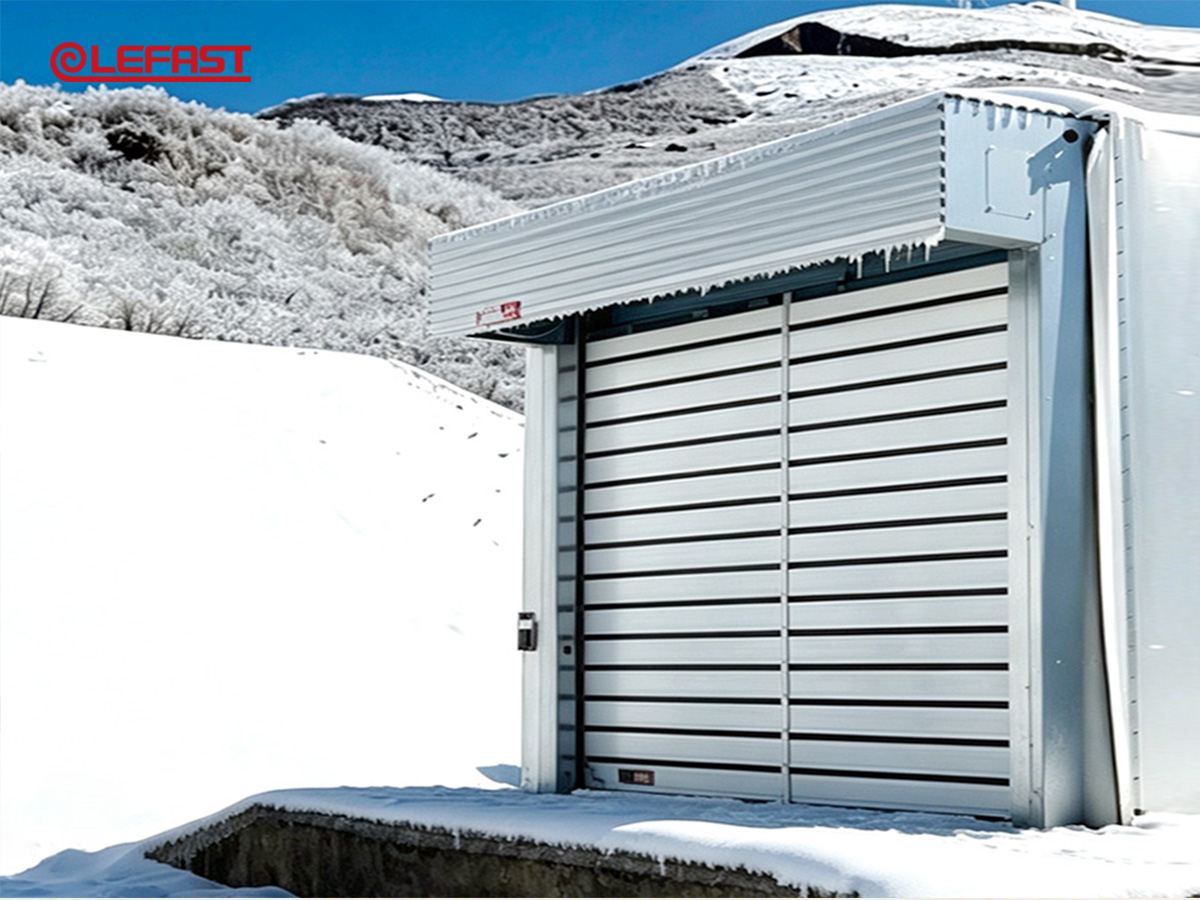
At the Guilin North Latitude 25 Ski Resort, two HSD4322 doors were installed on an air-supported structure. At the time, HSD4322Q was not yet available. Because of the wind conditions at the site, additional hinges were used to strengthen the door panel connection.
In projects such as the Xinjiang Wensu Coal Trading Center and a cement plant, the main concern was different. The door openings were about 4.5 m wide × 4 m high, and the surrounding areas had significant dust. Good sealing was an important part of the door selection.
In the Indonesia project, the opening was approximately 6 × 7 m. The building was in an open area with little protection from the surrounding environment, and the door faced the prevailing wind direction. Under these conditions, HSD4322 was not considered the preferred long-term option. The project used HSD8022 with an 80 mm insulated panel, providing a more substantial door structure for long-term use.
HSD4322 and HSD8022 were the earlier options in the range. As project requirements became more diverse ,HSD4322Q was designed later to provide greater panel strength than HSD4322 without moving directly to a full 80 mm panel. Now there are more options to meet different project requirements .
Planning an Air-Supported Structure Project, What information Should You Provide?
Before recommending a specific configuration, LEFAST normally looks at:
- Opening size ( W*H ) and quantity
- Installation location
- Operating frequency
- Insulation requirements
- Local natural conditions
- Working environment
- Project budget
9. FAQ
Q1. What information is needed before selecting a high-speed door?
You’d better provide :
- Opening size: W×H , available installation space ,
- Construction structure: such as Insulation panel structure / steel construction / reinforced concrete / air-supported structure etc.
- Application description: bulk material storage / sports & recreation / warehouse / logistics / vehicle or forklift access etc.
- Environmental: temperature or humidity requirements / corrosive environment / pressure requirements if applicable
- Operation requirements: daily use frequency / interlock or other automation requirements / other access conditions etc.
Q2. Which door type is suitable for larger openings?
In air-supported structures, door openings are commonly around 4,500 × 5,000 mm or smaller, depending on the structure and project requirements.
This size range , HSD4322 is a practical option for insulation and sealing in general industrial applications, If the opening is in a more wind-exposed area, HSD4322Q is more suitable because it is designed for higher wind resistance.
The final door selection should still consider the opening size, structure, traffic pattern, and local environmental conditions.
Q3. When should an insulated high-speed door be considered?
An insulated high speed door is considered for different temperature environment separation area , such as exterior entrance , or two temperature controlled area .
LEFAST HSD series uses insulated door panels in different thickness for different application choices.
Q4. Can high-speed doors be used for forklift or vehicle access?
Yes, high speed door is designed for frequent traffic, like forklift or vehicles , radar or other automation operation without requiring drivers to stop and operate the door manually.
Q5. Can Lefast provide customized solutions for air-supported structures?
Yes. Lefast evaluates air-supported structures, the solution involves structure, opening size, wind exposure, traffic conditions, and other site requirements ,
Q6. What experience does Lefast have with special applications?
Lefast has supplied high speed doors with special applications,such as wind-exposed area, air-supported structure etc. Including garage door at a fire station in Linzhi , Tibet , where the high altitude environment. And an air-supported ski resort in Guilin, where wind condition environment .
10. Conclusion
Choosing a high-speed door for an air-supported structure depends on Opening size, traffic frequency, pressure conditions, weather exposure, and thermal requirements , more than opening speed should all be considered before selecting the door type.
If you are planning an access opening for an air-supported structure, share your opening dimensions, site conditions, and access requirements with LEFAST. Our team can help you evaluate a suitable door type and configuration, and provide a project-specific quotation.
Back to Table of Contents