

Blog
High-Speed Doors vs Conventional Overhead Doors: Which Is Better for Your Facility?

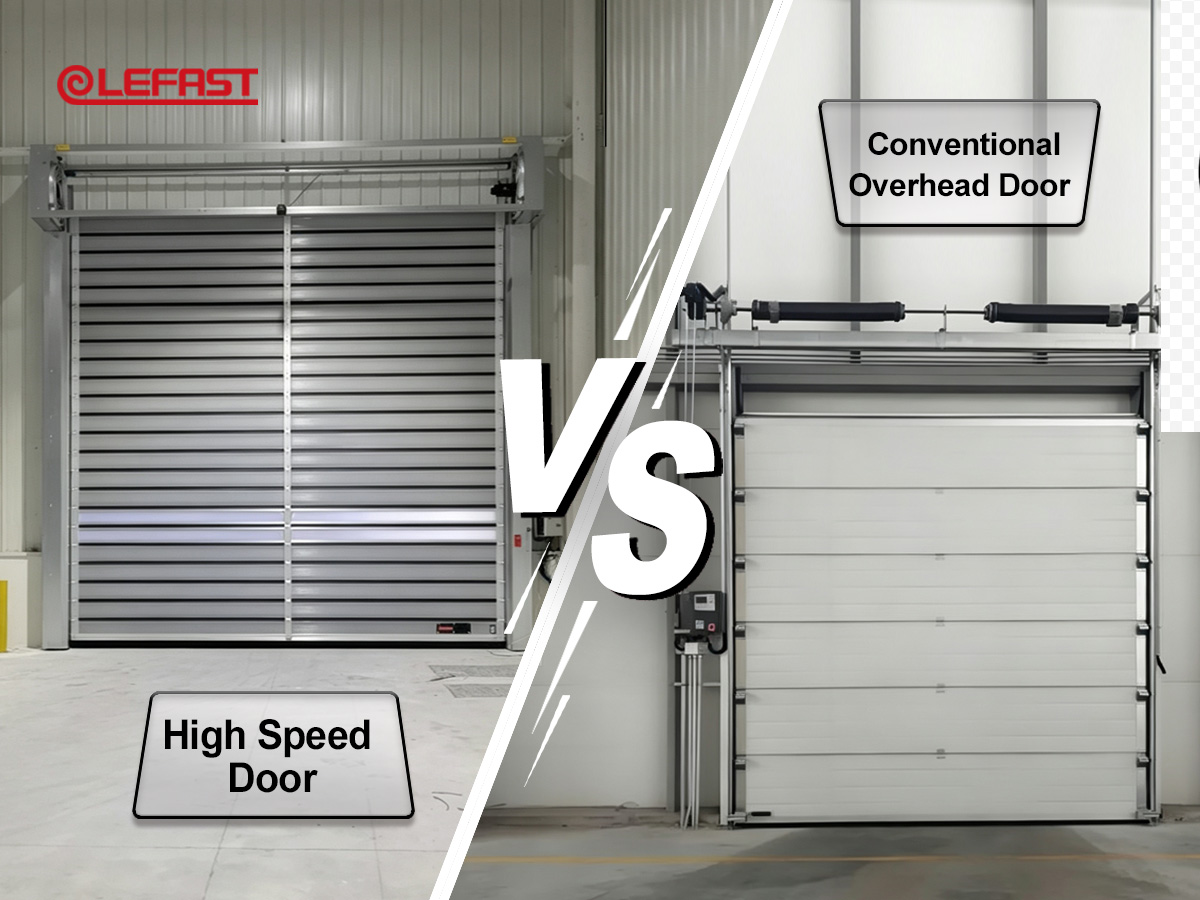
Table of Contents
- Introduction
- What Are High-Speed Doors?
- What Are Conventional Overhead Doors?
- High-Speed Doors vs Conventional Overhead Doors: Key Differences
- When Should You Choose High-Speed Doors?
- When Are Conventional Overhead Doors Still a Good Choice?
- Best Applications for Each Door Type
- Cost Considerations
- How to Choose the Right Door for Your Facility
- Why Industrial Facilities Choose LEFAST
- FAQ
- Conclusion
1. Introduction
When you compare high-speed doors vs conventional overhead doors, you will know high-speed doors are generally the better choice for facilities that require efficient traffic flow, environmental control, and process management. Beyond their fast opening and closing speed,high-speed doors can be integrated with PLC systems, access control systems, AGVs, conveyors, traffic lights, and interlocking systems to support safer operations and more standardized workflows.
All these makes them particularly suitable for warehouses, logistics centers, manufacturing plants, parking facilities, cold storage facilities, clean rooms and other automatic facilities where operational efficiency, safety, and process control are critical.
Conventional overhead doors remain a practical solution for low-traffic areas, projects where minimizing initial investment is the primary objective.
2. What Are High-Speed Doors?
High-speed doors are industrial door systems, designed for frequent operation and fast traffic flow. In general, industrial doors with opening speeds exceeding 0.6 m/s are defined as high-speed doors, while typical operating speeds range from 0.8 m/s to 2.5 m/s depending on the door type, opening size, and application requirements.
By comparison, conventional overhead doors usually operate around 0.15–0.25 m/s. This difference results from fundamentally different door structures, drive systems, and gearbox configurations, placing the two door types in entirely different performance categories.
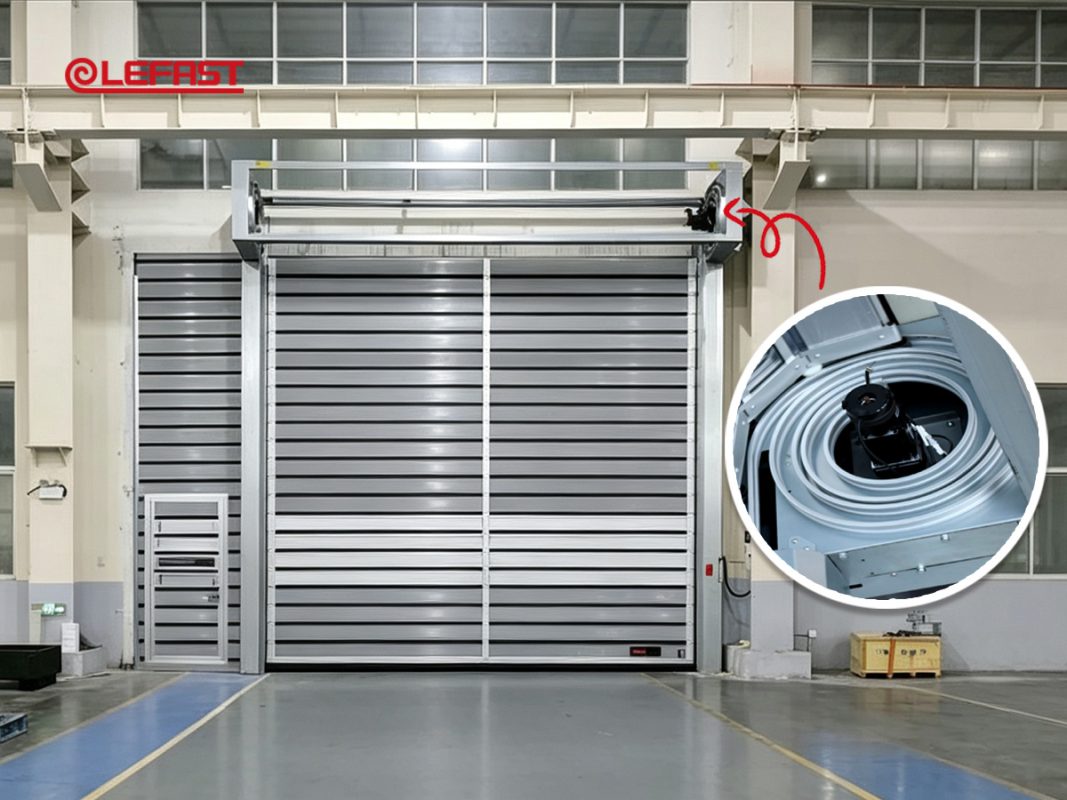
Modern high-speed door solutions include high-speed spiral doors, high-speed rolling doors, self-repairing high-speed doors, and cold storage high-speed doors, each designed to meet different and specific operational requirements.
Beyond speed, modern high-speed doors can be integrated with PLC systems, access control systems, AGV/RGV, conveyors, traffic lights, and interlocking controls. As a result, they not only improve traffic efficiency but also help support safer operations, better process management, and more streamlined production and logistics workflows.
In industrial applications, high-speed spiral doors are widely used as a representative solution for high-speed door systems due to their structural stability and suitability for high-frequency logistics environments.
3. What Are Conventional Overhead Doors?
Explain that conventional overhead doors are traditional commercial or industrial doors commonly used for general access, loading docks, garages, and lower-traffic areas.
Conventional overhead doors, also known as sectional overhead doors, are widely used in industrial and commercial buildings. For the purpose of this comparison, "conventional overhead doors" refer specifically to sectional overhead doors or sectional doors, which are the most common type used in industrial and commercial facilities.
These doors are suited for applications with relatively low traffic frequency or where temperature control and environmental separation are not critical. Common applications include storage buildings, maintenance workshops, commercial garages, loading docks, and general warehouse access points.
Their main advantages include flexible lift configurations, efficient use of building space, attractive appearance, and lower initial investment. While conventional overhead doors can be equipped with automation and access control features, they are generally not designed for the high-cycle, process-driven demands of modern logistics and automated production environments. For many industrial and commercial facilities, however, they remain a practical and cost-effective solution.
4. Main Differences Between High-Speed Doors and Conventional Overhead Doors
Upfront cost and long-term value
High-Speed Spiral Doors vs Sectional Doors: Key Differences
High-speed spiral doors are used here as the primary comparison reference against conventional overhead doors.
To better understand the differences between high-speed spiral doors and conventional overhead doors, the comparison can be made across several key operational aspects.
| Feature | High-Speed Spiral Doors | Sectional Doors |
| Opening Speed | 0.8–2.5 m/s | 0.15–0.3 m/s |
| Closing Speed | 0.6-1.5m/s | 0.1-0.2m/s |
| Safety | Integrated safety options | Standard safety options |
| Efficiency | High-cycle, fast traffic flow | Low to medium cycle use |
| Energy Control | Minimal air exchange | Longer open time, higher loss |
| Automation | PLC, AGV, conveyor, Smart factory ready | Modern systems supported |
| Durability | High-cycle design | Standard-duty design |
| Lifecycle Cost | Higher upfront, lower TCO | Lower upfront, higher long-term cost |
1) Speed & Operational Efficiency
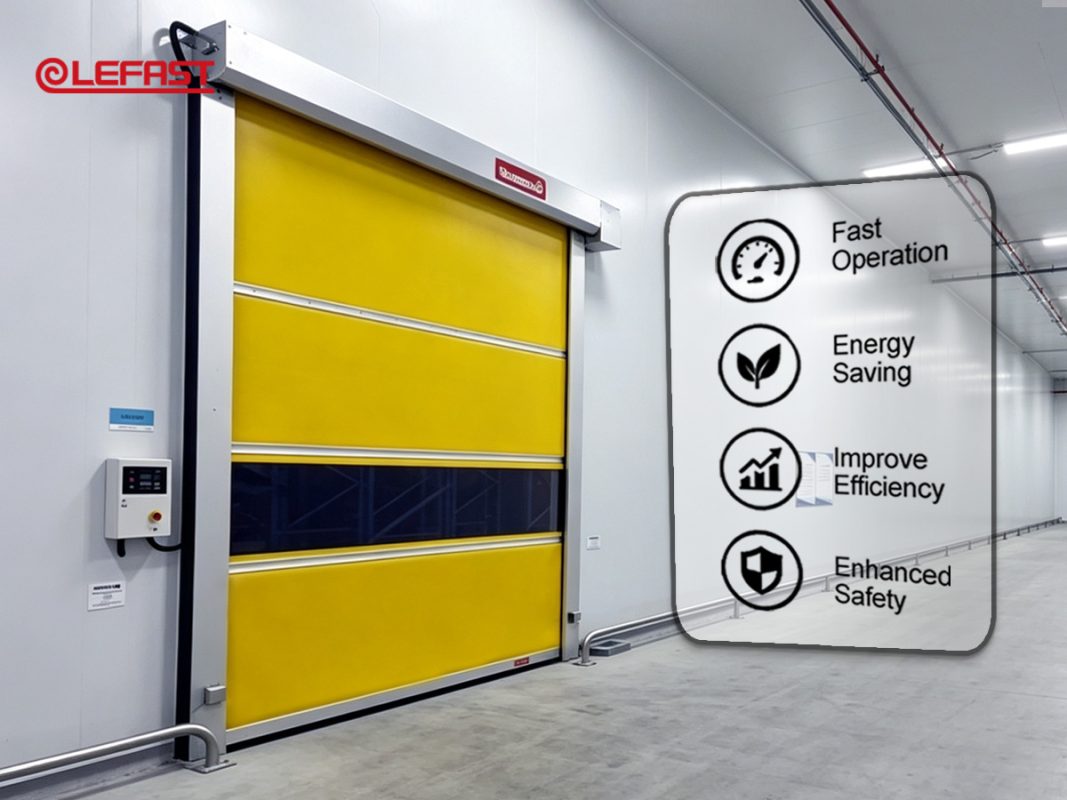
High-speed spiral doors complete opening and closing cycles several times faster than sectional overhead doors, reducing waiting time and improving traffic flow for forklifts, personnel, and automated equipment.
2) Energy Control & Traffic Flow
Both door types provide thermal insulation, but faster operation significantly reduces air exchange. This helps maintain more stable indoor temperatures, particularly in cold, windy, or high-traffic environments.
3) Automation, Safety & Future Scalability
Modern sectional overhead doors can support automation, but many older systems require control upgrades. High-speed spiral doors are designed for automated industrial environments from the outset, making them easier to integrate with AGV/RGV, conveyors, interlocking systems, and future smart factory upgrades.
Both door types support safety sensors, while high-speed spiral doors can also incorporate integrated light curtains and emergency manual opening.
4) Durability
High-speed spiral doors are engineered for high-cycle industrial operation. LEFAST doors have been independently tested for 500,000 trouble-free operating cycles, while some customer installations have exceeded 1.2 million cycles under routine maintenance, demonstrating long-term reliability in demanding environments.
Sectional doors are well suited to lower-cycle applications but may experience increased mechanical wear when operated frequently over extended periods.
5) Maintenance & Total Cost of Ownership (TCO)
Sectional doors generally have a lower purchase price, while high-speed spiral doors offer lower maintenance, less downtime, and better long-term value in high-frequency applications.
5. When Should You Choose High-Speed Spiral Doors?
High-speed spiral doors are recommended in industrial environments where operational efficiency, environmental control, and production continuity are critical.
They are best suited for facilities with frequent door cycles that directly impact workflow stability, energy efficiency, and process control.
Typical conditions include high-frequency traffic, strict temperature or air control requirements, and production environments requiring stable and uninterrupted material flow.
In these scenarios, high-speed spiral doors are commonly used due to their high-cycle performance and stable operation in demanding industrial environments.
6. When Are Sectional Doors Still a Good Choice?
Sectional doors are suitable for low-traffic areas, basic access points, storage buildings, garages, and cost-sensitive projects where frequent operation and strict environmental control are not primary requirements.
Modern sectional doors are not outdated systems. With updated control systems, they can still meet many industrial and commercial needs. However, in existing installations, older systems may not support direct integration with modern automation, and upgrades or control replacements may be required. Compatibility also depends on the original system and brand configuration.
For applications with lower operational demands, sectional doors remain a practical and widely used solution.
A detailed comparison of applications for both door types is provided in the next section.
7. Best Applications for Each Door Type
To help identify the most suitable solution for different environments, the following matrix matches typical applications with operational requirements and recommended door types.
This application matrix reflects typical industrial selection patterns based on operational requirements and system performance characteristics.
High-Speed Doors Application Matrix
| Application | Key Requirement | Recommended Solution |
| Automotive & EV industry | High-frequency cycles, production line coordination | High-speed spiral doors |
| Food processing plants | Hygiene control, frequent | High-speed spiral doors |
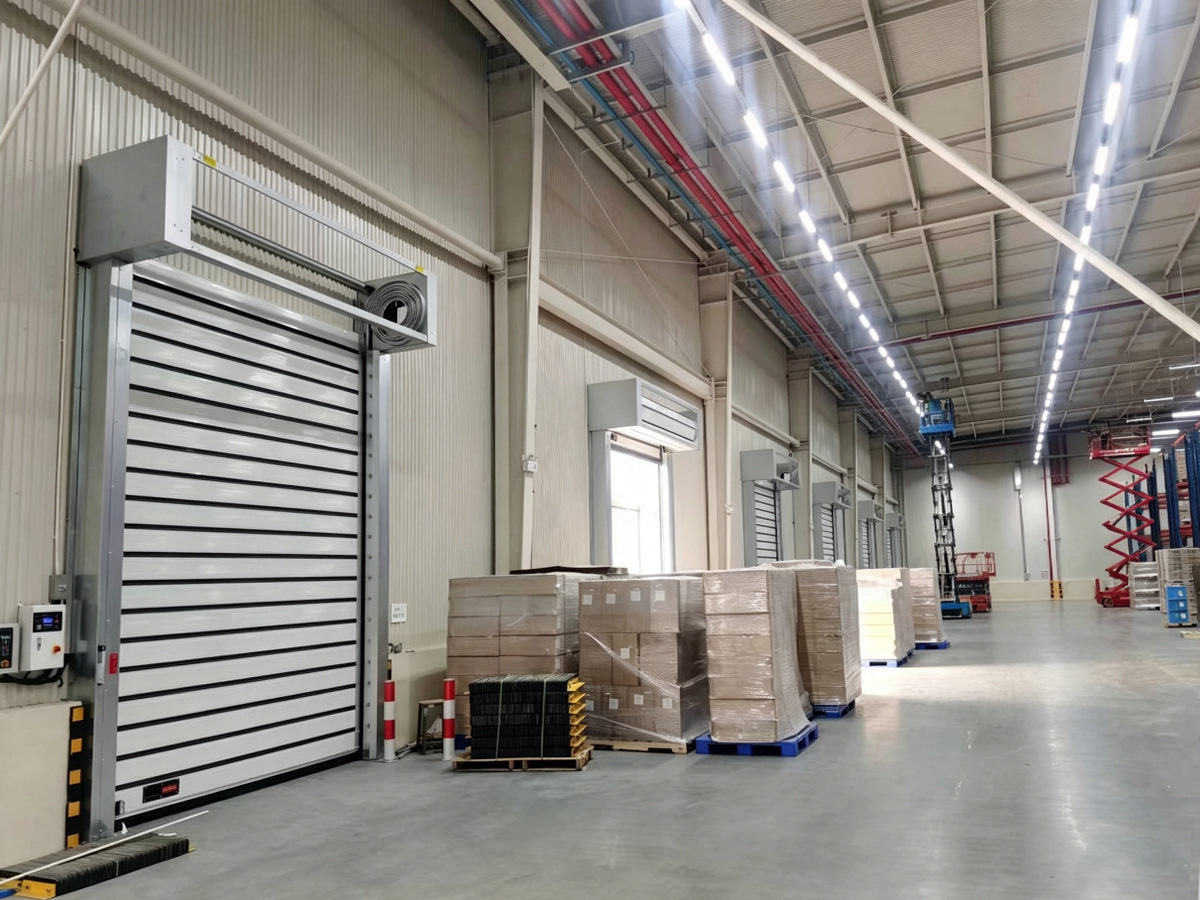
| Logistics & distribution centers | Fast material flow, forklift traffic efficiency | High-speed spiral doors |
| Manufacturing plants | Continuous production cycles | High-speed spiral doors |
| Cold storage facilities | Temperature stability, reduced air exchange | High-speed spiral doors |
| Cleanrooms | Strict environmental control | High-speed spiral doors |
| Automated systems (AGV / conveyors) | Synchronized access control | High-speed spiral doors |
| Parking facilities | High frequency traffic | High-speed spiral doors |
| Fire Station | Emergency & Rapid Response | High-speed spiral doors |
| High wind-load environments | Wind resistance, structural stability | High-speed spiral doors |
Conventional Sectional Doors Application Matrix
(also known in the market as industrial sectional doors or sectional overhead doors)
| Application | Key Requirement | Recommended Solution |
| Storage areas | Occasional access | Sectional doors |
| Low-traffic loading docks | Limited operation cycles | Sectional doors |
| General warehouse access | Standard industrial use | Sectional doors |
| Basic exterior entrances | Cost-sensitive applications | Sectional doors |
8. Cost Considerations
When evaluating industrial doors, the initial purchase price is only one part of the overall investment.
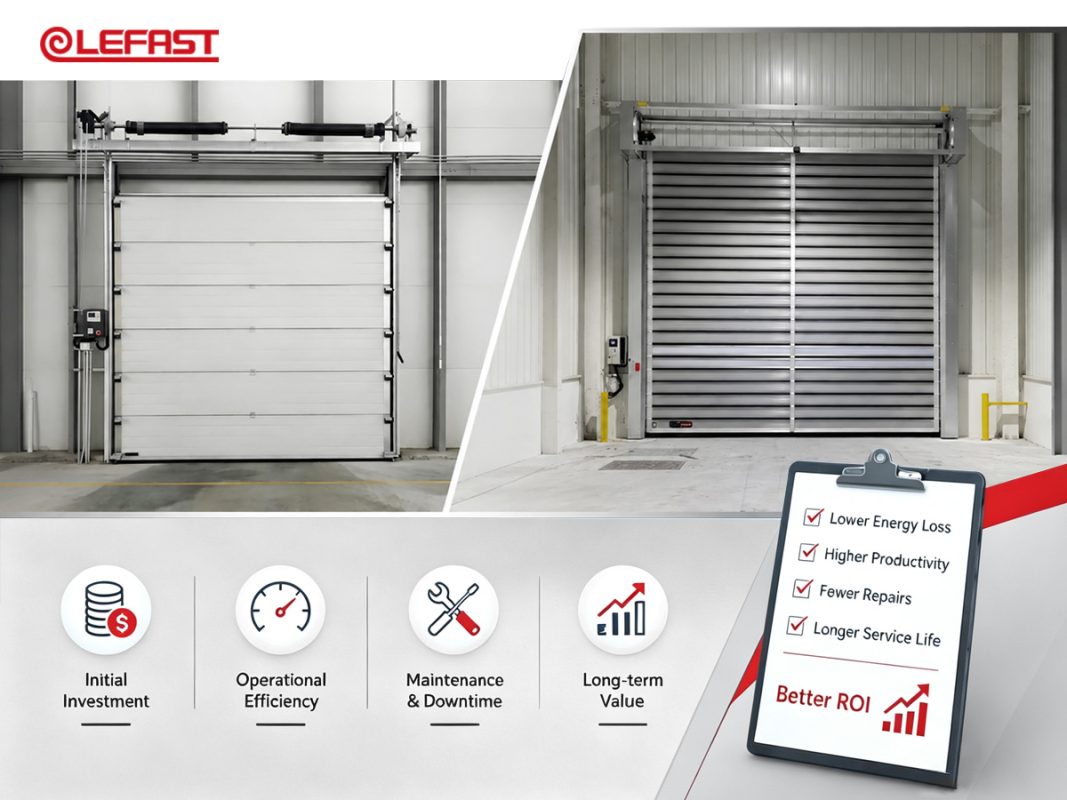
Sectional doors generally require a lower upfront investment, making them a practical choice for low-traffic applications or cost-sensitive projects.
High-speed spiral doors typically require a higher initial investment, but they often deliver greater long-term value in high-use industrial environments. Faster opening and closing speeds help improve operational efficiency, reduce waiting time, and minimize unnecessary air exchange, contributing to more stable production conditions and better energy control.
Maintenance and downtime should also be considered. Among high-speed spiral door solutions, high-speed spiral doors are particularly well suited for intensive industrial operation, requiring fewer routine wear-part replacements under normal maintenance conditions. In comparison, sectional doors rely on components such as torsion springs and lifting cables that require periodic replacement, especially in high-cycle applications.
For warehouses and manufacturing facilities, unexpected door failures may interrupt forklift traffic, delay production, and affect daily operations. In many cases, reducing operational downtime creates greater long-term value than simply lowering the initial purchase cost.
9. How to Choose the Right Door for Your Facility
Use the following checklist to quickly identify whether a High-Speed Spiral Door or a Sectional Door is more suitable for your application.
Step 1 — Operating Environment
- Indoor or outdoor use
- Temperature control requirements
- Wind exposure
Step 2 — Traffic Frequency
- Forklift traffic intensity
- AGV or automated vehicle usage
- Daily door cycles
Step 3 — Performance Requirements
- Opening speed
- Safety requirements
- Automation compatibility
Step 4 — Long-Term Cost
- Maintenance frequency
- Downtime risk
- Total Cost of Ownership (TCO)
Step 5 — Door Selection
- High-Speed Spiral Doors:
- High-frequency operation
- Automation / AGV integration
- Temperature or airflow control
- Continuous workflow environments
- Sectional Doors:
- Low-frequency access
- Basic industrial or commercial use
- Budget-sensitive projects
Selection Summary
Priority | Recommended Door |
High traffic / automation / smart | High-Speed Spiral Door |
Low traffic / basic access / budget | Sectional Door |
10. Why Choose LeFast High-Speed Doors?
LeFast provides high-speed door solutions for warehouses, factories, logistics centers, cold storage facilities, and other industrial environments requiring efficient and reliable access control.
Product Range
- High-Speed Spiral Doors
- High-Speed Rolling Doors
- Wind-Resistant Spiral Doors
- Self-Repairing High-Speed Doors
- Cold Storage High-Speed Doors
Value
By combining different high-speed door configurations, LeFast helps industrial users improve workflow efficiency, reduce operational interruption, and support modern automated facility requirements.
11. FAQ
Are high-speed spiral doors better than sectional doors?
High-speed spiral doors are better suited for high-frequency, automation-driven, and environment-controlled applications, while sectional doors are more suitable for low-frequency, basic access, and cost-sensitive projects.
What is the main benefit of high-speed doors?
The main benefit is improved operational efficiency through faster opening and closing, which helps reduce waiting time, support traffic flow, and minimize air exchange in controlled environments.
Are high-speed doors suitable for warehouses?
Yes. High-speed spiral doors are widely used in warehouses and logistics centers where frequent forklift movement and fast material handling are required.
Do high-speed doors help reduce energy loss?
Yes. Faster opening door reduce the duration of open-door time, helping limit air exchange between indoor and outdoor environments, especially in temperature-controlled facilities.
Are sectional doors cheaper than high-speed doors?
Yes. Sectional doors generally have a lower initial purchase cost, making them suitable for projects with limited budgets or low operational frequency.
Which door is better for forklift traffic?
High-speed spiral doors are better suited for frequent forklift traffic due to faster operation and higher cycle capability.
Which door is better for cold storage facilities?
High-speed spiral doors and cold storage high speed door designed for cold storage applications are more suitable because they help maintain stable internal temperatures through fast and controlled operation.
How do I choose between high-speed doors and sectional doors?
Selection depends on operating frequency, environmental requirements, automation needs, and long-term cost considerations. High-speed spiral doors are typically used for high-demand industrial environments, while sectional doors are used for general access applications.
12. Conclusion
High-speed spiral doors are ideal for high-traffic, automation-driven, and energy-sensitive industrial environments, where efficiency and continuous operation are critical.
Sectional doors are a practical choice for low-traffic applications and cost-sensitive projects with basic operational requirements.
The right selection depends on balancing traffic frequency, environment, automation needs, and long-term operating cost.
For project-specific advice, contact LeFast for a suitable high-speed door recommendation.