




Blog
How Do High-Speed Doors Enhance Operational Efficiency in Warehouses

Introduction
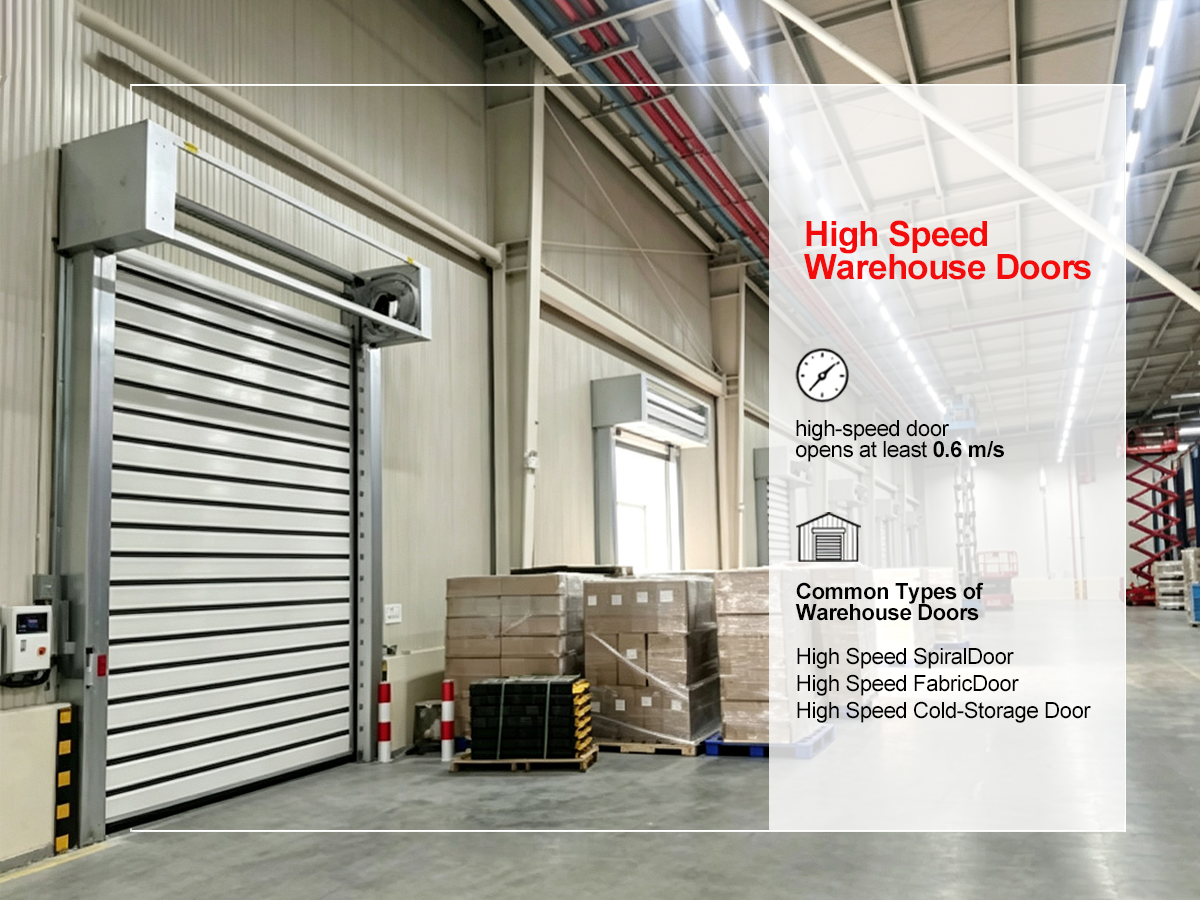
High speed warehouse doors help improve warehouse efficiency by reducing waiting time and supporting smoother movement of people, forklifts, pallets, and goods.
Different warehouse areas have different operating requirements. Busy entrances, internal separation areas, temperature-controlled zones, and forklift traffic routes may require different types of high speed doors. Choosing the right door solution helps keep warehouse operations moving efficiently.
1.What Are High Speed Warehouse Doors?
A high speed door is commonly defined as a door with an opening speed above 0.6 m/s in the industry. Internationally, terms such as high speed, fast, and rapid are more commonly used, without a unified speed threshold.
High speed doors are developed for industrial traffic openings that require fast and frequent access. They open and close quickly, are used in different working areas, can be operated automatically through different external signals.
High speed warehouse doors are available in different designs. Based on the door curtain or panel material and the mechanical structure of the complete door, common types include high speed rolling doors, folding doors, self-repairing doors, spiral doors, and cold storage doors.
2. How High Speed Doors Improve Warehouse Operational Efficiency
Reduce Waiting Time and Improve Traffic Efficiency
At busy warehouse access, door speed directly affects how quickly people, forklifts, pallets, and vehicles can pass through.
For example, with an opening H=3 m , a high speed door opening speed at 0.6–1.5 m/s takes about 2–5s to fully open. At a closing speed of 0.6–1.0 m/s, closing takes about 3–5s. With a 10-second closing delay, one complete opening-and-closing cycle takes roughly 15–20 seconds.
When the door is used repeatedly throughout the day, shorter opening cycles mean less waiting at the access point and smoother traffic flow. You can imagine how efficiency high speed industrial doors used practically in busy warehouse areas .
Keep Warehouse Workflows Moving
Warehouse doors may open and close hundreds of times during daily operation. Then, the mechanical structure and control system of industrial high speed doors are built for frequent operation, fast response, durable components, and stable control help the door keep working through repeated cycles.
Safety is also important part of warehouse high speed doors. During normal operation, infrared sensors, safety light curtains, safety edges, or other protection devices can detect obstacles and stop or reverse the door when necessary. In an emergency, functions such as emergency stop and manual or emergency opening when power off or unexpected situations.
The door served as a part of the warehouse workflow. Radar, ground loops, interlocking signals, or identification systems can be connected to the door control system to trigger automatic opening and closing. For example, a forklift approaching the doorway can trigger the door to open, while an interlocked door can open only after another door has closed.
Help Control the Warehouse Environment
A warehouse door separates two different environments. When the door stays open, air, dust, particles, and other unwanted substances can move between the inside and outside.
Warehouse high speed doors help reduce this exchange in two ways. Firstly, their fast opening and closing means the doorway exposure for less time. Secondly, the door structure and sealing design can reduce the gaps around the door when it is closed. In some warehouse applications, insulated door panels show better insulation performance.
3. Where Are High Speed Doors Used in Modern Warehouses?
Warehouse Receiving and Shipping Areas
Receiving and shipping areas are among the busiest points in a warehouse. Forklifts and other handling equipment may pass through the same doorway hundreds of times during daily operations.
A high speed door can open quickly when traffic approaches and close shortly after passage, helping keep the doorway available for movement without leaving the opening exposed for longer than necessary.
Internal Warehouse Partitions
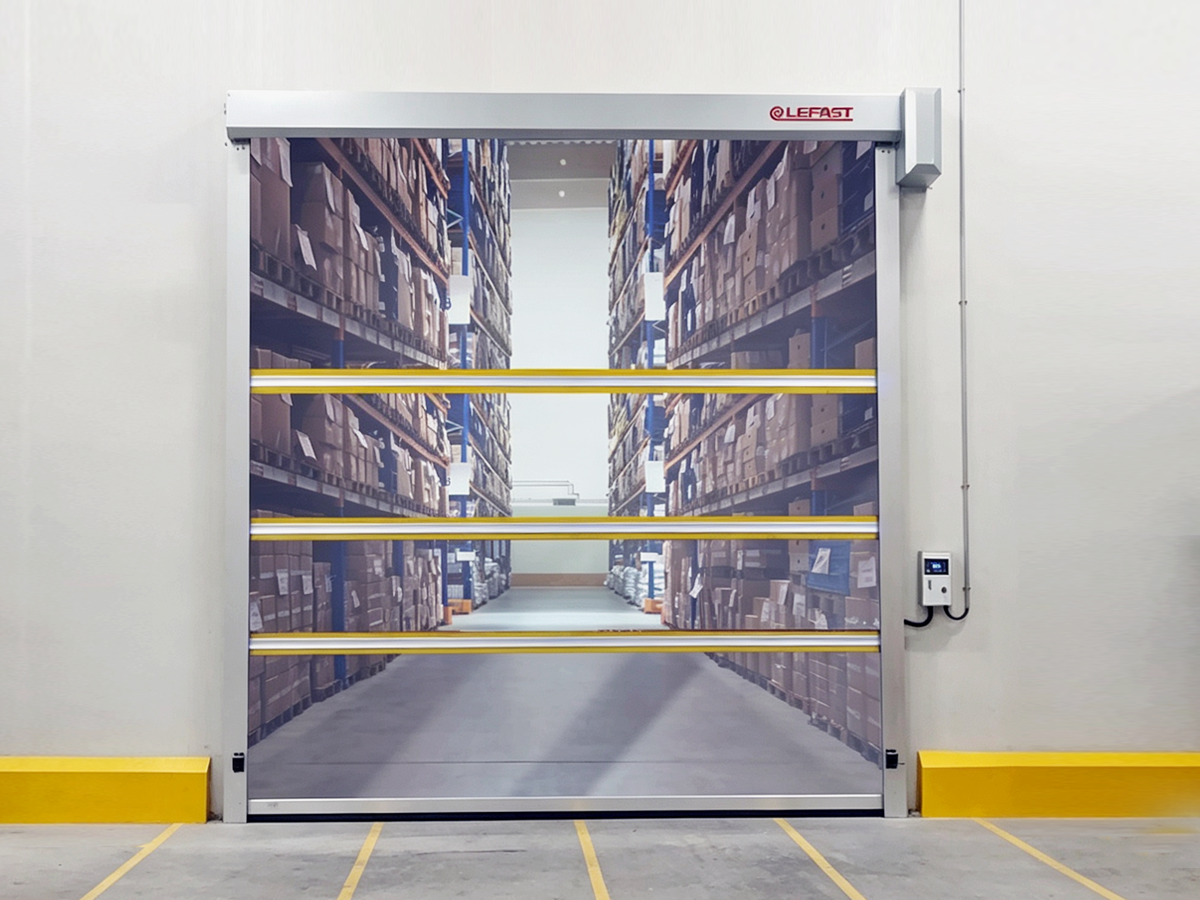
Internal openings between storage, packaging, production, and other areas often use fabric high speed doors.
High speed rolling doors are a cost-effective option. Where impact is more likely, self-repairing doors or zipper doors are commonly used. Transparent vision sections can also improve visibility between two sides of the opening.
Temperature-Controlled Areas
Different temperature-controlled warehouse applications require different high speed door types.
High speed spiral doors can be used as rigid roll doors for fruit ripening rooms. Self-repairing cold storage doors are commonly installed on the warmer side of cold rooms, such as buffer areas. For cold storage openings requiring higher insulation and sealing, high speed sliding cold storage doors can be used where there is enough installation space.
Clean and Controlled Areas
High speed rolling doors, also known as high speed warehouse roll up doors or high speed roll doors for warehouse, are widely used in clean areas.
For compact installation locations, clean room high speed doors with smaller head and side structures can be used. Self-repairing high speed doors are also suitable where frequent impacts may occur, reducing repair work and downtime.
Automated Material Handling Routes
Automation is becoming an increasingly important part of modern warehouse operations.
High speed doors can be connected with AGVs, AMRs, conveyors, and other automated material-handling systems may need to move through doors without interrupting the logistics process.
4. High Speed Doors vs Traditional Warehouse Doors
| Factor | High Speed Doors | Traditional Warehouse Doors |
|---|---|---|
| Opening speed | ≥0.6m/s | 0.1-0.3m/s |
| Traffic frequency | Suitable for frequent movement | Better for occasional access |
| Operating cycles | Designed for repeated operation | Usually used less frequently |
| Automation | Can connect with sensors, AGVs, and control systems | Depends on the door and control system |
The main difference is how the door handles daily warehouse traffic. Traditional warehouse doors remain suitable for openings where fast, frequent access is not required.
High speed doors for warehouse include high speed roll up doors, high speed spiral doors, and high speed folding doors.
5. How to Choose the Right High Speed Door for Your Warehouse
Operating Environment
Start by measuring the clear opening width and height. Then check the available installation space of headroom and side space . For a replacement or retrofit project, existing structures and nearby equipment should also be taken into account.
Thirdly, check the door location , know where warehouse high speed doors installed conditions around the opening, including temperature, humidity, dust, cleanliness, wind exposure, and the risk of forklift impact.
Door Application
Consider where the door will be used. Common applications include external entrances and loading areas, internal warehouse passages, cold storage and buffer rooms, clean areas, and production or automated material-handling routes.
Look at how the door will work in that location. Consider what passes through the opening, traffic frequency, required opening speed, and how the door will be activated—such as by radar sensor, push button, remote control, or other access devices.
The door needs to work with an AGV, conveyor, production line, or warehouse control system, some external signals or system integration are required.
Supplier Capability
Though high speed door itself is very important, the supplier must be able to match the door to the actual application. Choose one supplier for high speed doors manufacturers, you can check product range, customization capability, technical support, system integration, and after-sales service
6、Why Choosing the Right High Speed Door Manufacturer Matters
Content direction::
Naturally introduce LEFAST.
Emphasize that procuring high-speed industrial doors involves not only purchasing a product, but also:
- product suitability;
- customization capability;
- long-term support。
Avoid expressions that cannot be verified, such as "best manufacturer" or "number one supplier."
The right high-speed door manufacture does more than supplying a door. It helps make sure the door fits the application, meets the project's requirements, and can be supported throughout its service life.
For example, different warehouse areas may require different door solutions. LEFAST uses HSR high speed rolling doors for ambient warehouse applications and RCD high speed cold storage doors for low-temperature areas. The choice of high speed warehouse door depends on factors such as temperature, traffic frequency, sealing requirements, and how the space is used.
Project requirements need the door to work with automated equipment. In a vitamin production project, 24 HSD4322 high speed spiral doors were installed at material transfer points used by AGVs. All the doors side columns and head box covers are stainless steel. The doors received wireless signals from the AGV system, allowing the vehicles to trigger the doors during material movement. With an opening speed of up to 1.5 m/s, the doors were integrated into the material flow rather than operated manually.
A high speed door manufacture should be support the solution can meet every different meets for any projects, including door dimensions, control signals, opening and closing sequences, safety devices, or other configurations.
Support after installation also matters. High speed doors in busy warehouses may cycle many times a day, making maintenance, spare parts, troubleshooting, and technical support part of their long-term operation.
For LEFAST, these three aspects—choosing the right product, adapting it to the project, and supporting it after installation—are considered together when developing high speed door solutions for warehouses and other industrial applications.
FAQ
FAQ 1: Are high speed warehouse doors suitable for every warehouse?
No. High speed warehouse doors are most useful in areas with high traffic, frequent opening cycles, or a need to improve the flow of people, vehicles, or materials.
For low-traffic areas where the door is opened only occasionally, a conventional industrial door may be sufficient.
FAQ 2: How do high speed doors improve warehouse productivity?
High speed doors can reduce the waiting time at frequently used access points and help keep vehicles, workers, and materials moving between different areas. Faster opening and closing also helps maintain operational continuity when doors need to cycle repeatedly throughout the day.
FAQ 3: What is the difference between high speed roll up doors and traditional industrial doors?
The main differences are door curtain/panel material, speed, operating frequency, and application. High speed roll up doors means fabric curtain with opening speed 0.6-1.5m/s, are designed for frequent opening and closing, and suitable for busy warehouse entrances and internal traffic routes.
Traditional industrial doors generally operate at speed of 0.1-0.3m/s and are often used for lower frequent.
The right choice depends on how the door will be used rather than speed alone.
FAQ 4: How often do high speed warehouse doors require maintenance?
Maintenance should follow the manufacturer's recommendations and take the actual operating conditions into account, maintenance frequency depends on usage frequency, operating environment, and door type.
FAQ 5: What information should I prepare before requesting a high speed door quote?
You can provide the opening width and height, installation environment, expected traffic frequency, and the intended application. If the door needs to connect with equipment such as AGVs or a building control system, the relevant control or integration requirements , if possible you can provide the picture of the application.
FAQ 6: How do I choose the right high speed door manufacturer?
Look at more than the product price. Consider the manufacturer's products range, project cases, production capability, ability to customize solution for specific projects, and technical support after installation. A manufacturer that can support the door from product selection through installation and long-term operation can make the purchasing decision easier and reduce problems later.