




Blog
High-Speed Doors for Food Processing Facilities: Hygiene, Traffic Flow & Temperature Control

Introduction
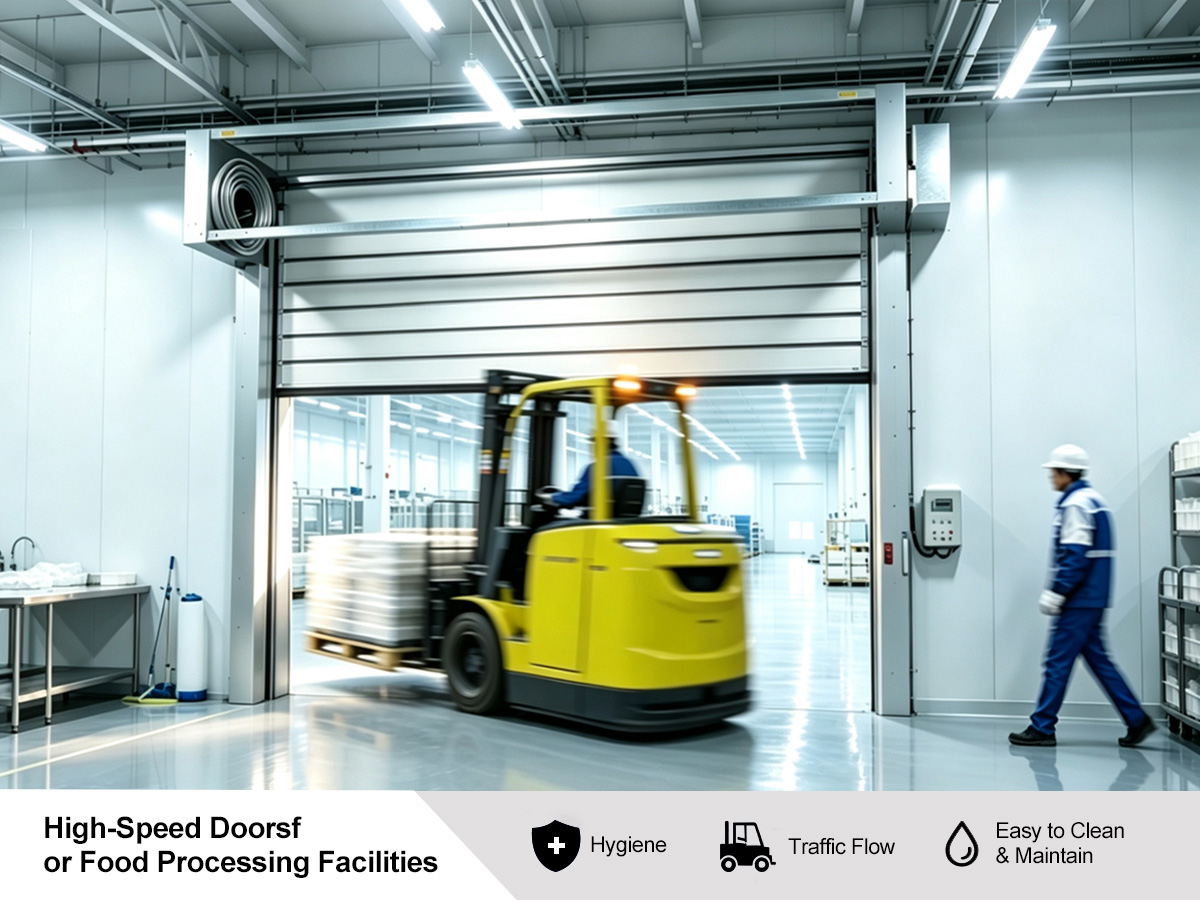
Food processing facilities need to keep production areas clean while allowing people, carts, forklifts, and materials to move efficiently. Frequent door openings can also increase air and temperature exchange between areas.
High speed industrial doors shorten the time an opening stays exposed, while proper sealing and suitable materials help with hygiene and area separation. When selecting a door, the key factors are the installation location, traffic, environmental conditions, hygiene requirements, temperature, and sealing performance.
1. What Is a High Speed Door for Food Processing Facilities?
A high speed door is an automatic industrial door designed to open and close faster than conventional doors, typically at speeds above 0.6 m/s. In food processing facilities, it is commonly used at openings with frequent personnel, material, or equipment movement.
Generally speaking, high speed doors are used in food processing can generally be divided into high speed fabric doors with fabric curtain door , high speed spiral doors with insulated panel doors, high speed cold storage doors.
High speed fabric doors use flexible PVC curtains with 0.8-1.8mm thickness, and are suitable for frequent personnel, cart, and material traffic.
High speed spiral doors use rigid insulated panels or thermal-break construction, and are suitable for applications requiring better insulation, sealing, or structural strength.
Cold storage doors including high speed freezer doors and high speed sliding doors .
2. Why Do Hygiene, Speed, Sealing, and Automated Operation Matter in Food Processing
Hygiene
The door itself should use suitable, environmentally friendly materials that do not create contamination through aging or wear during normal use. Its sealing design should also help keep out dust, insects, and other unwanted contaminants when closed.
Speed
Fast opening and closing reduces exposed the time in the doorway , limiting unnecessary exchange of air and particles between areas.
Sealing
Sealing of food processing facility doors helps maintain separation between different areas and limits the entry of dust, insects, and unwanted air when the door is closed.
Automated Operation
Sensor-based operation reduces manual handling and unnecessary contact, helping limit contamination caused by touching the door during frequent traffic.
3. Where Are High Speed Doors Used in Food Processing Plants?
Raw Material Receiving and Storage Areas
Used at receiving entrances and transfer openings where materials move frequently , the doorway needs to remain closed between movements.
Production and Processing Areas
Used between production areas where personnel and materials move frequently, different work zones need to be separated.
Clean and Hygienic Areas
Used between areas with different hygiene requirements where limiting dust, insects, and unwanted air movement is important.
Packaging and Production Lines
Used around production and packaging lines where frequent material movement calls for quick and reliable access.
Cold Rooms and Temperature-Controlled Areas
Used at cold storage and temperature-controlled openings where frequent traffic makes fast cycles ,insulation and sealing important.
Warehouses and Logistics Areas
Used at internal and external logistics openings for frequent movement of goods, carts, and forklifts.
Loading and Unloading Areas
Used at loading and unloading openings where goods frequently move between indoor and outdoor areas.
Washdown and Sanitation Areas
Used at entrances to washdown or sanitation areas where moisture and frequent access need to be considered.
4. How Can High Speed Doors Support Hygiene in Food Processing?
Separating Different Hygiene Zones
The better high speed warehouse doors sealing can help separate areas with different hygiene or processing requirements. Side and bottom seals, with the door structure, help keep out dust, insects, and unwanted air when the door is closed.
Reducing Unnecessary Air Exchange and Contact
The speed of high speed industrial door is above 0.6m/s , fast door cycles shorten the time exposed opening, reducing unnecessary exchange of air and airborne particles. Automatic activation by radar, access control, or other sensors can also reduce manual touch the door.
Easy-to-Clean Design
Door materials and surfaces should suit the facility's cleaning requirements. Smooth surfaces and frame materials make routine cleaning easier, while durable materials, aluminium alloy / stainless steel / galvanized steel, help avoid contamination caused by material wear during long-term operation.
5. How Do High-Speed Doors Improve Traffic Flow?
In food processing facilities, people, forklifts, carts, and materials often move through the same openings day by day. High-speed doors help keep personnel and material movement smooth by reducing opening time, minimizing waiting, and responding to traffic automatically.
Faster Movement and Less Waiting
High speed warehouse doors can fully open around 3-5s as opening H=3–4.5m, with opening speeds up to 2.0 m/s based on selected models. This helps moving among processing, packaging, storage, and other areas , reduces waiting time for employees, forklifts, and carts
In continuous testing, high-speed doors have completed up to 1 million opening and closing cycles, supporting applications where the same passage is used repeatedly throughout production. For high-traffic openings, consistent repeated operation is always important.
Automatic Activation and Workflow Integration
The activation method for each opening is depending on the door model and site requirements, radar sensors, push buttons, pull cords, touchless switches, remote controls, or vehicle detection can be used. Radar detection is commonly set at around 2–3 m and can generally be adjusted within 5 m.
At the same time, the door can also respond to an AGV signal or other external signal for automated material handling, Where separation between areas is required, two doors can be interlocked so they do not open at the same time. More functions allow door operation to follow the actual movement of people and materials rather than interrupt it.
6. How Can High-Speed Doors Support Temperature Control?
High performance doors cannot control the temperature itself, but its operating speed, insulated construction, and sealing can help limit heat and air exchange when these areas are separated with different temperature requirements for food processing facilities.
Reducing Air Exchange Between Temperature Zones
Warm and cold air can exchange through the opening between ambient and chilled areas. The longer doors stays open, the greater temperature will be fluctuation and condensation in potential.
Fast opening and closing reduces the exposure time, at the same time, door curtain or insulated door panels and perimeter seals help limit air exchange after the door closes. Therefore, these features can help maintain more stable conditions in temperature-sensitive processing areas.
Supporting Refrigerated Areas and HVAC Efficiency
Cold storage and refrigerated rooms are particularly sensitive to repeated door openings. Limiting warm-air entry can reduce the amount of cooling required to restore the target temperature.
For facilities with frequent traffic between temperature-controlled zones, a properly selected cold storage doors (high speed freezer doors or cold storage sliding doors) can support refrigeration and HVAC systems by reducing unnecessary thermal exchange, rather than leaving temperature control entirely to the equipment.
7. What Features Should a Food Processing High-Speed Door Have?
Hygienic Materials for the Operating Environment
Material selection depends on the door type, cleaning method, moisture, temperature, and frequency of use. PVC curtains are available in different formulations, fabric structures, and thicknesses, such as 0.8, 1.2, and 1.8 mm, to suit different applications.
Materials and wearing parts should remain stable during normal operation and cleaning, without creating unwanted odors, loose particles, or residues.
Sealing and Cleanable Design
Side and bottom seals use EPDM rubber. Insulated panels also use EPDM seals between panels to maintain sealing across the door.
Surfaces around the door should be easy to inspect and clean, with limited areas where water or residues can remain.
Fast and Reliable Door Cycles
Frequent-use doors are exposed to repeated opening and closing every day. Drive systems, controls, and mechanical components need stable performance over continuous cycles.
Cycle testing provides a practical way to assess this, helps the door operate correctly and maintain consistent operation after extended repeated use.
Safety and Access Control
Photocells, light curtains, and other protection devices can be used where required. Radar, touchless switches, or other automatic activation & control methods match the traffic opening for personnel , forklifts or automated equipment ,can reduce manual operation and make busy passages easier to use.
Easy Maintenance and Serviceability
Curtains, seals, and other wearing parts require periodic inspection and replacement. Components are easy to access and replace and help avoid unnecessary production downtime.
8. High-Speed Doors vs. Conventional Industrial Doors in Food Processing Facilities
Conventional industrial doors can include sectional doors, roller shutters, or manually operated doors, depending on the application. They can work well for low-frequency access. High-speed doors are more suitable when an opening is used frequently or separates areas with different environmental requirements.
| Factor | High-Speed Door | Conventional Industrial Door |
|---|---|---|
| Opening / Closing Speed | >0.6m/s | 0.1-0.4m/s |
| High-Frequency Traffic | Up to 2,000 cycles per day | Better suited to lower-frequency access |
| Environmental Separation | Short opening time helps limit air exchange | Longer opening time may allow more air exchange |
| Temperature Control Support | Helps limit exposure between different temperature zones | Less suitable for frequently accessed temperature-controlled openings |
| Automatic Activation | Various automatic activation options | Depends on door type and configuration |
| Hygiene Considerations | Materials, sealing, and cleanable design can be selected for the environment | Depends on the specific construction and materials |
| Typical Applications | Production, processing, packaging, chilled areas, busy logistics routes | Low-traffic storage, service areas, infrequently used openings |
The choice depends on how the opening is used. A conventional door may be sufficient where traffic is limited. Where frequent movement and environmental separation are both important, a high-speed door is often the more practical option.
9. How to Choose a High-Speed Door for a Food Processing Facility
Identify the the Area and Environmental Conditions
Start with where the door will be installed, receiving, production, packaging, cold storage, warehouse, and personnel passages have different requirements.
Check the surrounding conditions as well, including temperature, moisture, humidity, cleaning methods, and whether the area is subject to regular washdown.
Determine Traffic Type and Frequency
Look at who or what uses the opening and how often. There will be very different requirements for people, carts, forklifts, pallets, or automated equipment.
The clear opening size should match the traffic as well. Check the required width ,height and installation space of right/left/upper, based on the largest load or vehicle using the opening, while allowing enough clearance for safe movement.
Define Hygiene, Sealing, and Temperature Requirements
Look at the cleanliness requirements, cleaning procedures, temperature differences between adjacent areas, and the level of separation needed to help determine the required materials, sealing, and door construction without selecting features that the application does not need.
Select Activation and Safety Systems
Activation should follow the traffic pattern. Radar, push buttons, pull cords, untouch switches, or vehicle detection may suit different applications, depending on the application requirements.
Safety devices such as photocells and light curtains should be considered alongside the traffic type and operating conditions.
Check Integration and Maintenance Requirements
Some openings may need connection with access control, door interlocking, production lines, automated material handling, or other facility systems.
Maintenance also matters with components, replacement of wearing parts, spare-part availability, and the time required for routine service.
A Quick Selection and Practical Checklist :
- Application location and opening size
- Who or what passes though
- Traffic frequency
- Hygiene requirements
- Sealing requirements
- Temperature difference
- Water or moisture exposure
- Curtain and frame material
- Safety Sensors
- Activation,automation and integration requirements
- Maintenance: requirements
10. What High-Speed Door Features Are Suitable for Different Food Processing Areas?
| Application Area | Key Selection Consideration | Key Door Requirements |
|---|---|---|
| Receiving | Forklifts, pallets, frequent traffic | High cycle capability, suitable opening size, safety |
| Production | Frequent traffic, hygiene requirements | Cleanable design, sealing, reliable cycles |
| Packaging | Personnel and material movement | Hygiene, sealing, suitable activation |
| Cold Storage | Low temperature, temperature differences | Insulated construction, sealing, fast operation |
| Washdown Areas | Water, moisture, frequent cleaning | Suitable materials, moisture resistance, cleanable design |
| Warehouse | Forklifts, pallets, repeated traffic | Opening size, cycle performance, safety |
| Personnel Passages | Pedestrian traffic | Suitable size, automatic activation, safety |
| Processing Zone Connections | Different cleanliness or temperature zones | Sealing, environmental separation, traffic control, interlocking where required |
11. How to Choose the Right LEFAST High-Speed Door for a Food Processing Facility
Lefast is one of the high speed doors manufactures and cold room doors manufactures, supports lots of food facilities projects.
A 3 m-wide opening doesn’t need the same door fo a food processing facility. The right choice is depending on where it is installed and how it is used.
For an exterior workshop door with higher insulation and sealing requirements can use HSD4322 high speed spiral door .
For a warehouse, high speed warehouse doors can select HSD spiral doors, or high speed fabric doors, even high speed freezer doors.
For an indoor partition where some insulation is required, HSD27150 high speed spiral door is an option. If insulation is not required, HSR high speed rolling door can be used for general indoor traffic. Where an indoor opening has a higher risk of forklift impact, RSD self-repairing high speed door or RZD high speed zipper door can be considered because their curtains are designed for self-repairing after impact.
The requirements change in temperature-controlled areas. HSD4322 high speed spiral door can be used for fermentation or maturation rooms where insulation and sealing are important, while RCD self-repaired cold storage door is designed for low-temperature cold storage applications. HSD high speed spiral door can also be used in spray or washdown areas where the door is exposed to water and frequent cleaning.
For cleanrooms, HSR high speed rolling door can be commonly used. Where a higher cleanliness level is required, RSD self-repairing doors, RZD zipper doors, or RCL cleaning room doors can be considered.
Stainless steel configurations are available for applications with specific material requirements.
The same door type may also serve different areas. The door opening, traffic, temperature, cleaning method, hygiene requirements, and operating conditions should be considered together.
12. FAQ
Why are high-speed doors used in food processing facilities?
They reduce opening time during frequent traffic. This helps limit unnecessary air exchange and supports separation between production areas.
What type of high-speed door is suitable for food processing plants?
It depends on the opening, traffic, temperature, hygiene level, cleaning method, and other site conditions. Different applications may require insulated doors, self-repairing doors, or doors designed for higher cleanliness requirements.
How do high-speed doors help maintain hygiene in food processing areas?
Fast opening and closing reduces the opening exposure time to the surrounding environment. Suitable materials, sealing, and cleanable surfaces also help keep the doorway easier to maintain.
Can high-speed doors help control temperature in food processing areas?
Yes. Faster door cycles reduce the time between warm and cold areas. Insulation and sealing become more important where the temperature difference.
Are high-speed doors suitable for washdown areas?
Yes, they can designed the door materials, seals, and components suit for the water exposure and cleaning method. The specific washdown conditions should be checked when selecting the door.
How are high-speed doors activated in food processing facilities?
Common options include radar sensors, push buttons, pull cords, touchless switches, vehicle detection, and external control signals. The available options depend on the door type and application.
Can high-speed doors help separate different hygiene zones?
Yes. A fast-closing, well-sealed door can help reduce exposure between areas with different cleanliness requirements.
13. Conclusion
A food processing high-speed door needs to fit the opening, traffic, temperature, hygiene, and cleaning conditions of the site. Different areas may call for different door designs.
LEFAST offers HSR, HSD, RCD, RCL, RSD, and RZD for different food processing applications.
Send us the door opening size, application, traffic, temperature, and cleaning requirements. We can help you select a suitable door type and configuration.