




Blog
Industrial Doors for Retail Distribution Centers: Choosing the Right Solutions for Receiving, Storage, and Shipping

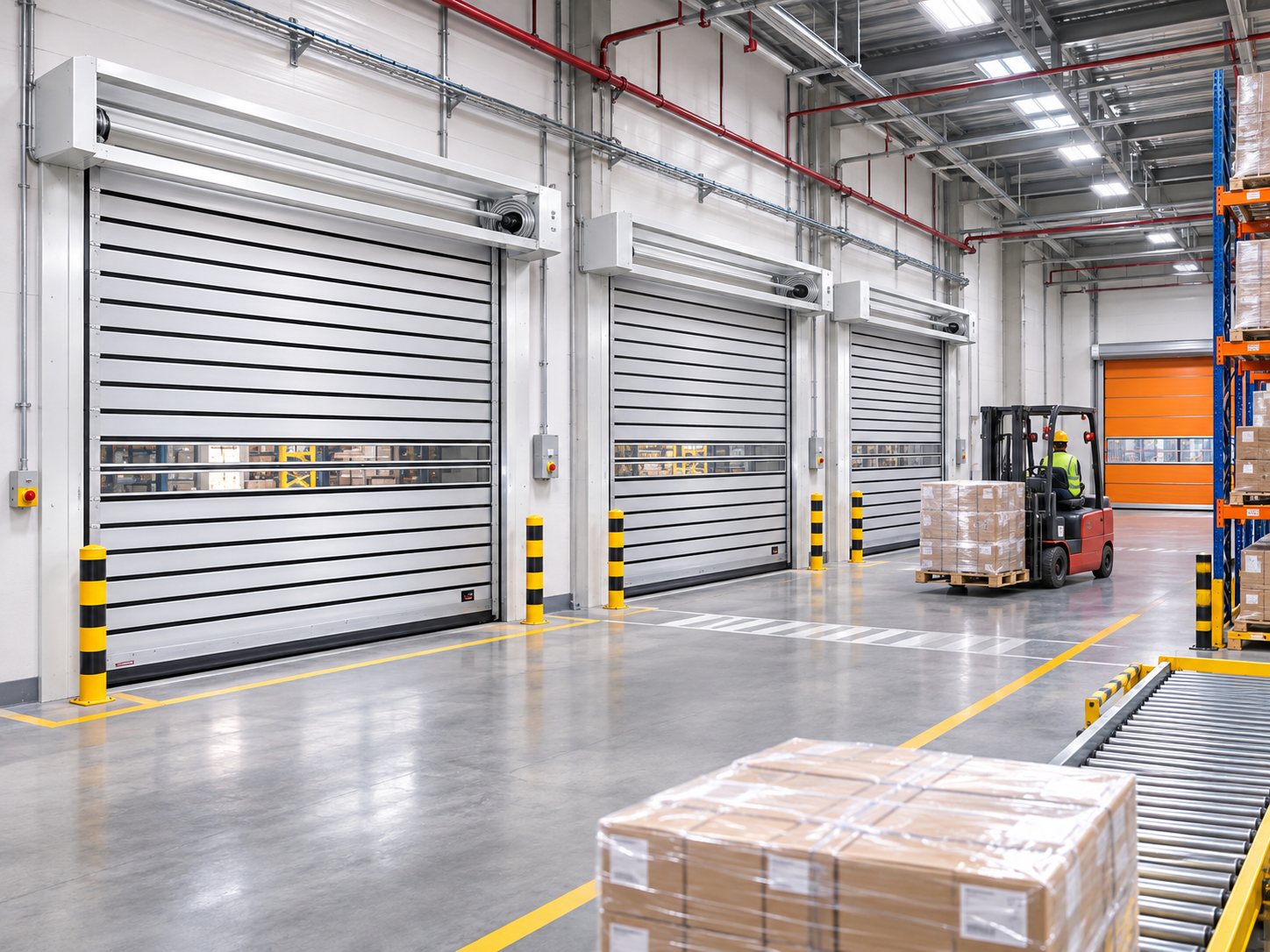
Retail distribution centers need different types of industrial doors for different parts of the building. Receiving docks, storage areas, picking zones, and shipping entrances all handle different types of traffic, so choosing one door configuration for the entire facility rarely makes sense. The right combination of doors can help keep goods moving, separate working areas, and manage exposure to outdoor conditions and temperature changes.
A distribution center can be busy even when trucks are not arriving. Forklifts move pallets between storage locations, employees pick and pack orders, and outbound shipments are prepared throughout the day. Every doorway along these routes affects how easily people and equipment move through the building.
For facility managers planning a new warehouse or upgrading existing entrances, the first step is to understand what happens at each opening. Traffic frequency, vehicle dimensions, available installation space, and environmental conditions should all influence the choice of door.
1. What Should Retail Distribution Centers Consider When Choosing Industrial Doors?
Retail distribution facilities typically have several distinct working areas. Incoming goods pass through receiving docks before moving to inspection and storage. Products then travel through picking and packing areas before reaching outbound shipping.
These areas do not have identical access requirements.
An external loading entrance may need a rigid door that can handle a large opening and regular vehicle movement. An internal passage used by forklifts throughout the day may be better suited to a flexible rolling door. Refrigerated storage entrances require additional attention to insulation and sealing.
When assessing high speed doors for a distribution facility, start with a few practical questions:
- How frequently will the door open during normal and peak operating hours?
- Will forklifts, pallet trucks, pedestrians, or delivery vehicles use the opening?
- What clear width and height are needed for equipment to pass safely?
- Is the door exposed to rain, wind, dust, or significant temperature differences?
- Does the opening need to connect with sensors, conveyors, or warehouse control systems?
It is also worth considering what happens when a door is open. An entrance connecting an indoor storage area with an outdoor loading dock has different requirements from one separating two internal warehouse zones.
These details help narrow down the options before comparing individual models.
2. Receiving Docks: Handling Incoming Shipments
Receiving docks are among the busiest areas in a retail distribution center. Trucks arrive with incoming inventory, forklifts unload pallets, and goods move toward inspection or temporary storage.
A door at this location needs to work with the loading dock rather than operate as a separate piece of equipment.
A high speed overhead door may be considered when frequent opening and closing are part of daily operations. The selection should also account for the opening dimensions, structural support, installation clearance, and exposure to outdoor weather.
Rigid high speed spiral doors are one option for larger industrial entrances. Their insulated rigid panels and guided opening structure make them different from flexible PVC curtain doors.
LEFAST offers several models in its HSD series. HSD27150 is associated with industrial logistics applications, while HSD4322 is listed for larger industrial openings and frequent use.
One useful reference is LEFAST's published logistics project in Kuala Lumpur, Malaysia. The installation used an HSD27150 door with a 4 × 4 m opening. The door was coordinated with a dock shelter and loading platform through an interlocking arrangement.
For a retail distribution facility, this is a useful example of how entrance equipment can be planned together. Door operation, truck positioning, dock equipment, and the movement of incoming goods all need to be considered during the design stage.
3. Warehouse Storage Areas: Keeping Forklift Traffic Moving
After receiving, products are transferred to bulk storage, pallet racks, picking locations, or other inventory areas.
Forklifts and pallet trucks may pass through the same internal openings dozens of times during a shift. A door that takes too long to operate can interrupt this movement, particularly when several work areas depend on the same access route.
When evaluating high speed industrial doors for warehouse passages, consider the actual traffic pattern rather than relying on the advertised maximum opening speed alone.
A rigid spiral door may suit an opening that needs a more substantial structure. Flexible rolling doors are another option for internal passages where frequent access and straightforward movement are priorities.
LEFAST's HSR1000 is a flexible high-speed rolling door intended for frequent industrial traffic. Its product page lists an adjustable opening speed of 0.6–1.2 m/s and a closing speed of 0.6 m/s.
Those figures apply to the HSR1000 specifications published by the manufacturer. They should not be treated as standard speeds for the entire product range.
For facilities with several connected storage areas, it is also worth reviewing how each door affects the surrounding environment. A passage between two ambient-temperature warehouse zones has different requirements from one connecting a warehouse with a refrigerated room.
4. Picking and Packing Areas: Separating Work Zones
Picking and packing operations involve a different mix of activity. Employees move between storage locations and order preparation stations, while forklifts and pallet trucks transport products to packing and dispatch areas.
The door selection should reflect this combination of pedestrian and equipment traffic.
High speed fabric doors are worth considering for internal passages and working-area separation. These doors use flexible curtain structures, with different configurations available for different industrial applications.
For example, HSR1000 is designed for frequent industrial traffic. RSD1000 uses a self-recovery structure that allows the curtain to return to its guide after certain impact-related dislodgements.
That feature can be useful in busy warehouse environments where forklifts repeatedly pass through internal openings. It does not mean the curtain is immune to damage, however. Vehicle clearance, operator awareness, and appropriate traffic procedures remain important.
Visibility is another detail that should not be overlooked. If people and forklifts approach the same opening from opposite directions, the facility should consider whether the door configuration provides sufficient visibility and whether additional warning or detection devices are needed.
The Occupational Safety and Health Administration (OSHA) provides guidance on warehouse safety and forklift hazards, including pedestrian awareness and the separation of vehicle and pedestrian routes.
5. Cold Storage: Choosing Doors for Temperature-Controlled Areas
Some retail distribution centers handle frozen food, fresh produce, dairy products, and other temperature-sensitive inventory. These operations often involve several temperature zones, from ambient storage to refrigerated and frozen areas.
The entrance between these spaces deserves particular attention. Repeatedly opening a door between areas with different temperatures can allow unwanted air exchange, especially during busy loading periods.
This is where cold storage doors become relevant.
LEFAST's cold storage range includes three main models: RCD3000, RCS3000, and RCS5000.
The RCD3000 features a double-layer insulated curtain and a heated guide system. Its product page lists a curtain thickness of 20 mm, an adjustable opening speed of 0.8–1.2 m/s, and a suggested closing speed of 0.6–0.8 m/s.
The RCS3000 and RCS5000 use insulated sliding door structures. Their published product information describes a 100 mm overall door thickness with polyurethane insulation.
The choice between these models depends on the installation. Temperature differences, opening dimensions, available side space, and daily traffic should all be reviewed before selecting a configuration. The single- and double-leaf arrangements also need to be confirmed against the actual project dimensions.
LEFAST has published several cold-chain project examples involving RCS3000 installations. One describes multiple entrances at a cold-chain distribution center, while another covers a direct sliding door arrangement between a warm-side area and frozen storage.
These examples show why the position of the door matters just as much as its model. A cold storage entrance should be planned around the movement of goods and the temperature conditions on both sides.
It is also important to keep expectations realistic. A door can help reduce the time an opening remains exposed, but it cannot independently guarantee a particular energy saving or temperature-control result. The building envelope, loading procedures, traffic frequency, and other refrigeration equipment all play a part.
6. Outbound Shipping: Planning for Large Openings and Regular Dispatches
Outbound shipping brings together the work completed in the earlier stages of distribution. Finished orders are consolidated, moved to loading areas, and transferred onto delivery vehicles.
During busy dispatch periods, several entrances may be operating at once. The doors need to accommodate the size of the vehicles and the way goods move through each loading bay.
For larger industrial openings, industrial folding doors are another option to evaluate.
LEFAST's HPD2000 uses a reinforced folding structure with a PVC curtain. Its published specifications include:
- Width of 2,000–7,000 mm with an external motor installation.
- Width of 2,000–6,000 mm with an internal motor installation.
- Height of 2,000–6,000 mm.
- Adjustable speed of 0.5–0.8 m/s.
The motor position affects the available width, so it should be discussed during the initial layout stage. The product page provides one speed range without separately identifying opening and closing speeds.
HPD2000 is positioned for larger industrial openings, including logistics and loading-related applications. For an external shipping entrance, wind exposure, supporting structures, and the available motor installation space should also be checked.
If a facility has multiple shipping bays, consistent equipment specifications can make it easier to organize operating procedures and maintenance. However, the same door should not automatically be specified for every bay. Differences in opening dimensions and site conditions may call for different configurations.
7. Matching Door Types to Different Areas of a Distribution Center
A useful way to plan industrial doors is to work through the building one area at a time.
The following comparison provides a starting point for discussions with a door manufacturer.
| Distribution Center Area | Main Requirement | Door Type to Consider |
|---|---|---|
| Receiving docks | Frequent vehicle access and loading coordination | High-speed spiral doors |
| Internal warehouse passages | Repeated forklift and pallet movement | Flexible rolling or spiral doors |
| Picking and packing areas | Separation of internal working zones | Flexible fabric doors |
| Refrigerated storage | Insulation and temperature separation | Cold storage doors |
| Frozen storage entrances | Insulated access and temperature control | Sliding or self-recovery cold storage doors |
| Large shipping openings | Larger dimensions and structural requirements | High-speed folding or spiral doors |
This is not a fixed specification for every distribution center. A warehouse with a high volume of forklift traffic may have different requirements from one that mainly handles pedestrian picking and smaller deliveries.
The final choice should be based on the actual opening, operating conditions, and the technical information available for the selected model.
8. Safety, Automation, and Installation: Details to Address Before Ordering
Industrial doors in a distribution center share space with forklifts, conveyors, employees, and delivery vehicles. Their operation needs to fit into the facility's wider safety and control arrangements.
There are several points worth discussing before an installation begins.
Activation and vehicle detection
Radar sensors, ground loops, remote controls, and pull switches can be used for different operating situations.
For example, a vehicle detection system may be appropriate at a receiving entrance, while a door connected to an internal conveyor may need to respond to signals from the material-handling system.
The activation method should match how traffic approaches the opening. A sensor that triggers too early or too late can interfere with vehicle movement.
Integration with warehouse automation
Some distribution facilities use automated guided vehicles (AGVs), conveyors, and warehouse control systems to move products between different areas.
LEFAST has documented an automated warehouse project for Gerflor involving HSD4322 doors connected with warehouse control and AGV signals. Another published project describes 24 HSD4322 doors connected with AGV operations at a vitamin C manufacturing facility.
These examples provide useful references for projects involving automated material movement. They do not establish that every door model is compatible with every AGV or warehouse platform.
Before specifying an integrated system, the manufacturer and automation provider should confirm the required interfaces, signal timing, opening sequence, and safety interlocks.
Safety devices and emergency operation
Photoelectric sensors, light curtains, safety edges, and airbags should be checked against the exact door model and configuration. Some are standard on particular models, while others are optional.
It is also worth discussing how the door responds to an obstruction, a power interruption, or conflicting signals from connected equipment.
Emergency operation should be included in the installation and handover documentation so that facility personnel understand how to respond if normal operation is unavailable.
Site measurements
Before ordering, record the following information:
- Clear opening width and height.
- Available headroom and side clearance.
- Installation depth and supporting structures.
- Motor location and electrical supply.
- Forklift, pedestrian, and delivery vehicle routes.
- Indoor and outdoor environmental conditions.
- Required control interfaces and safety equipment.
Headroom deserves particular attention in existing buildings. Pipes, overhead services, beams, and other structural elements can affect the available installation space. A standard product configuration may need to be adjusted to suit the actual site.
9. What Should You Look for in an Industrial Door Manufacturer?
Comparing manufacturers only by price or advertised opening speed can leave important questions unanswered.
For a retail distribution center, it is worth looking at the manufacturer's product range, technical documentation, project experience, and ability to discuss the requirements of individual openings.
Product selection: Does the manufacturer offer different door structures for loading docks, internal passages, and temperature-controlled areas?
Technical documentation: Are the opening dimensions, operating speeds, motor requirements, and safety configurations available for the specific model?
Customization: Can the proposed door accommodate limited headroom, unusual building structures, or different motor positions?
Automation: Can the manufacturer explain the control interfaces and integration requirements for warehouse equipment?
Project experience: Are there documented installations involving logistics facilities, loading docks, or automated warehouses?
Maintenance and support: Are inspection procedures, replacement parts, installation assistance, and maintenance responsibilities clearly explained?
LEFAST is a high-speed industrial door manufacturer based in Qingdao, China. Its published range includes high-speed spiral doors, flexible fabric doors, cold storage doors, and folding doors. The company also documents applications in warehouse logistics, automated material handling, and temperature-controlled facilities.
Facilities researching high speed warehouse doors can review the relevant product specifications and project examples before discussing a proposed configuration with the manufacturer.
Conclusion
The right industrial door arrangement for a retail distribution center depends on what happens behind each opening. Receiving docks need to accommodate incoming shipments, internal warehouse passages handle repeated forklift movement, and cold storage entrances have to account for temperature differences.
A rigid spiral door, flexible rolling door, or insulated cold storage door may each be suitable in different parts of the same building.
Before making a decision, facility managers should review traffic frequency, clear opening dimensions, installation conditions, safety devices, and any required automation connections. Comparing these details against the manufacturer's model-specific documentation makes it easier to identify a suitable configuration and avoid unnecessary changes during installation.